Data inputs
- OCEL 2.0
- XES
- CSV & Parquet
Bring any event or object-centric data.
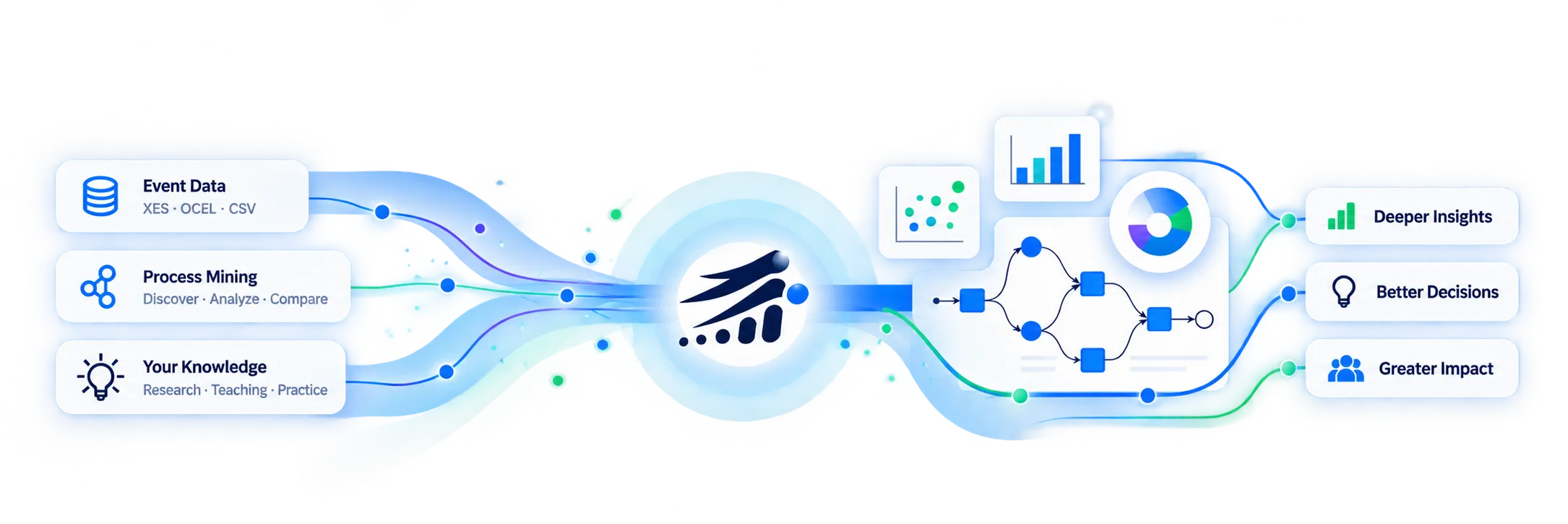
Welcome to Promenade
Based on decades of research. Built with the latest web technologies. Designed to be open, scalable, and accessible for everyone who wants to turn data into insights.
Built on the foundations of process mining research
State-of-the-art web technologies and open standards
From classroom examples to real-world data
Researchers, students and practitioners
The whole pipeline
Data inputs
Bring any event or object-centric data.
Open compute
Open languages, high performance, local by default.
Interactive analysis
Explore, validate, and improve with confidence.
See it run
This is the workspace layout — artifacts on the left, a tabbed analysis pane in the center, and properties on the right.
Scale
Start on a five-megabyte sample in a browser tab. Point the same workspace at a container on your laptop when the log reaches gigabytes, or at an engine on your own infrastructure when it reaches terabytes. Same artifact tree, same plugins, same clicks — you change one dropdown.
DuckDB-wasm and WebAssembly plugins. Nothing is uploaded, because there is no server.
One container, one command. Native plugin runners, real threads, spill-to-disk.
The identical image, next to the warehouse. Your network, your keys, your audit trail.
Same discovery run, three engines — more data, and more throughput to match.
Move an artifact to an engine and the heavy data stays there. Only metadata, previews and the paged results you actually look at cross the network — so a terabyte log never has to become a terabyte download. Artifacts on an engine stay in the same tree, with a badge rather than a separate list.
How engines workOne workspace, four ways in
I'm new to process mining
A demo log is already loaded. Fifteen minutes from a table of events to a model you can explain out loud.
Start the beginner trackI run process work in a company
One export, one laptop, no procurement cycle. Rework, waiting time and conformance on your own data this week.
Open the practitioner trackI work on process mining itself
Object-centric techniques, exact alignments and runs a reviewer can retrace. Publish your technique as a plugin others install in one click.
Open the expert trackI'm building with Promenade
Ship your algorithm as a plugin in Rust, Python, SQL or TypeScript. One manifest, one data door, provenance for free.
Plugin quickstartCapabilities
Every capability below is in the core open-source application today. Nothing here is a roadmap item or a paid add-on.
A streaming parser feeds DuckDB-wasm; artifacts persist as compressed Parquet in the browser's own file system and survive a reload.
Import the formats you already have, map columns to case, activity and timestamp, and get a first model in the same session.
Object-centric Petri nets, OC-DFGs, TOTeM, an object-centric Inductive Miner, replay and a metro-map view — not a bolt-on mode.
Alignment-based replay computes the cheapest alignment per trace variant. Exact, computed locally, and animated over the model.
Algorithms, views, importers and exporters are all plugins — ours included. Yours installs exactly the same way.
When a log outgrows the tab, point the workspace at a Docker engine on your machine or one on your own infrastructure.
Extensibility
Nothing is welded into the core: miners, conformance checkers, renderers, importers and exporters all arrive through the same plugin interface, and everything shipped with Promenade goes through it too. Write one, and it sits beside ours in the action menu.
Rust compiled to WebAssembly, Python through Pyodide, SQL against the relational API, or TypeScript for views. One manifest format covers all four.
The same bundle executes in the browser tab, in a Docker engine on your laptop and on an engine beside your warehouse. You do not port anything.
A plugin reads the log through a read-only SQL interface and renders into a sandboxed iframe. It cannot quietly reach past either.
Alpha Miner (Classic) · BPMN 2.0 · Cardinality Impact Explorer · Cases & Variants (OCEL) · DECLARE · Directly-Follows Graph (Rust) · Dotted Chart…
Develop
Declare the artifact types your action consumes and produces; the host handles data access, color, selection and provenance. Ship the bundle next to the paper and a reviewer runs it in one click.
{
  "id": "org.acme.my-miner",
  "runtime": "wasm",
  "actions": [{
    "id": "discover",
    "inputs":  { "log": "EventLog" },
    "outputs": [ "AcceptingPetriNet" ]
  }]
}
Research
Every artifact records the action, the parameters and the runtime version that produced it. A workspace exports as a bundle — log, models and provenance together — so the figure in a paper can be reopened rather than described.
Provenance is a DAG, not a filename convention. Re-run a chain with one parameter changed and keep both results side by side.
XES, CSV, OCEL 2.0 (JSON and SQLite) and PNML in and out — no proprietary container in the middle.
A new discovery algorithm or conformance technique is a plugin, not a fork — against the same interface the built-ins use.
Canonical citation metadata lives with the source, so a paper can point at a version rather than at a website.
Open source
There is no upgrade path, because there is nothing to upgrade to. Promenade is open source — fork it, cite it, teach with it, or ship a plugin that becomes part of it.
Open the application and start working. Your data stays in your browser — or on your own engine — unless you export it.
The application, the plugin runtime and every algorithm implementation are on GitHub under an open-source license.
Algorithms arrive as plugins from the people who published them. Discussion, issues and roadmap are all in the open.
Free, open source, and running before you finish reading this sentence. When the log outgrows the tab, the same workspace points at an engine — nothing about your analysis changes.